
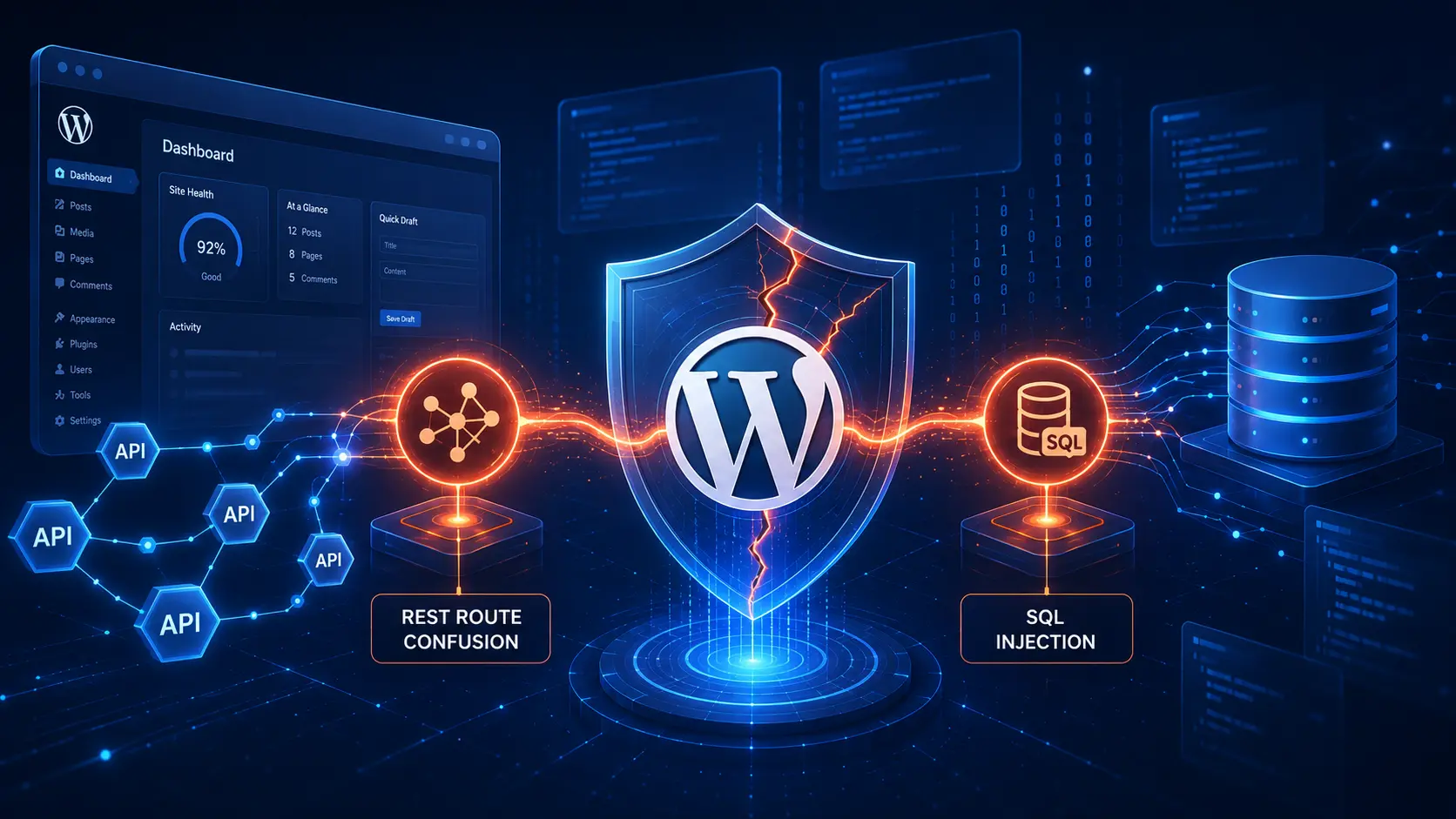

A Clean Installation Compromised
A fresh WordPress installation.
No third-party plugins.
No custom code.
No stolen administrator password.
Yet an unauthenticated attacker could still find a path to server-side code execution.
This was the reality for specific, unpatched releases of WordPress 6.9 and 7.0. The vulnerability was disclosed by Searchlight Cyber under the name "WP2Shell," while WordPress released patched versions on July 17, 2026. The absence of a vulnerable plugin is what made the finding especially uncomfortable.
The obvious question is: how could two seemingly unrelated bugs turn a clean WordPress installation into a target for remote code execution?
The Two Flaws Behind WP2Shell
WP2Shell was not a single catastrophic error. It chained two separate vulnerabilities that combined REST route confusion with SQL injection:
| Vulnerability | What it affected | Role in the chain |
|---|---|---|
| **CVE-2026-63030** | REST batch handling | Created route and handler confusion |
| **CVE-2026-60137** | WP_Query author filtering | Allowed unsafe input to reach SQL |
Individually, each flaw exposed a different weakness. The real danger appeared when they were placed on the same execution path.
How the Chain Worked
Based on the technical vulnerability analysis by Patchstack, the exploit required specific alignment between the two components.
The First Bug: Breaking Request Handling
- What WordPress expected: The REST API batch endpoint bundled multiple requests. It expected the validation logic to map perfectly to the execution logic.
- What actually happened: An indexing alignment issue disconnected incoming requests from their matched handlers. The system checked permissions for one route but executed a different one.
- Why it mattered: The route confusion allowed the request to be validated against the wrong handler. As a result, the expected type validation did not run before the value reached the actual callback.
The Second Bug: Exposing the Database
- Expected behavior: The query layer's
author__not_inparameter expected an array of integers. Sanitization relied entirely on that type. - Where the assumption broke: An attacker provided an unexpected string, bypassing the integer-specific conversion process. The unvalidated value reached the SQL query construction.
- Security impact: The query layer incorporated the unsafe value into the SQL clause, trusting that the REST layer had already enforced the required input type.
The Path to Control
When successfully chained, the vulnerabilities could turn an unauthenticated request into privileged WordPress access and server-side code execution.
Nothing in this chain looked catastrophic in isolation. One component mishandled request alignment. Another trusted a parameter type too much. The takeover emerged only when those assumptions met.
Note: WordPress-level RCE executes code as the web-server user (like www-data). It does not automatically grant operating-system root access.
Understanding the chain explains the risk. The next question is whether a particular WordPress installation was exposed.
Immediate Action for Administrators
If you are managing a WordPress installation, check your version immediately.
| Version | Status | Action |
|---|---|---|
| 6.7.x and earlier | Not affected | Normal maintenance |
| 6.8.0–6.8.5 | SQL injection only | Update to 6.8.6 |
| 6.9.0–6.9.4 | Affected by the complete WP2Shell chain | Update to 6.9.5 |
| 7.0.0–7.0.1 | Affected by the complete WP2Shell chain | Update to 7.0.2 |
Patching stops future exploitation. However, if you suspect your site was already compromised, you must audit accounts, inspect files, rotate secrets, and consider restoring from a verified backup.
Key takeaway: If you are running WordPress 6.9.0–6.9.4, update to 6.9.5 or later. If you are running 7.0.0–7.0.1, update to 7.0.2 or later. Do not rely only on plugin vulnerability scans because these issues were present in WordPress Core.
Why Ordinary Assumptions Failed
Patching the affected installations solves the immediate problem. But the more interesting engineering question is what allowed both flaws to survive until release.
The batch endpoint was not inherently dangerous. Neither was the author exclusion parameter. The problem appeared in the space between them.
Neither component appeared catastrophic on its own. The vulnerability emerged because validation performed in one layer was trusted by another layer that never verified the assumption again.
Could a standard security review have caught this? On the database side, a reviewer might notice SQL created through string concatenation or unsafe parameter types. But the REST route-confusion is much harder to spot. It requires a deep contextual understanding of nested dispatch behavior—a reviewer must realize that parallel arrays might become misaligned.
Reducing Risk with Layered Code Review
To catch complex assumption failures, the OWASP Secure Code Review Cheat Sheet recommends combining automated analysis with manual secure-code review, particularly when vulnerabilities depend on application logic, authorization boundaries, or interactions between multiple components.
This is where tools like CodeRabbit fit into a modern pull request workflow. According to its documentation, CodeRabbit acts as an automated review layer that analyzes new pull requests and performs incremental reviews after additional commits. It surfaces potential issues while the pull request is still under review, giving developers a chance to address them before the code reaches the main branch.
Crucially, it does not replace threat modeling, unit testing, SAST scanners, or human security specialists. It acts as one component of a larger defensive system.
The Lasting Lesson for Developers
The tools matter, but the deeper lesson is not about any single scanner or review platform.
The most dangerous vulnerabilities happen when two components make incompatible assumptions about data or permissions. Security is an end-to-end property.
- Enforce input handling: Are types strictly enforced, or can malformed input bypass sanitization?
- Verify authorization: Is the same handler used for validation and execution?
- Layer your controls: Are automated scans and human approvals required before merging sensitive logic?
Lessons for Framework Authors: Cross-component assumptions are difficult to test because isolated unit tests may not reproduce the real interaction between validation, routing, and execution layers. End-to-end integration tests, property-based testing, and fuzzing across component boundaries can help expose these gaps before release.
WP2Shell is a reminder that serious vulnerabilities don't always come from dramatic mistakes. More often, they emerge when individually reasonable components trust each other a little too much. Building secure software means challenging those assumptions before attackers do.